https://medium.com/@ranjanunicode22
If you’ve worked with large language models long enough, you’ve probably hit the same wall:
Memory becomes the bottleneck before compute does.
Not model weights.
Not training.
Not even latency.
It’s the KV cache.
As context windows stretch from 8K → 128K → 1M tokens, the KV cache quietly explodes into gigabytes per request — killing throughput, increasing cost, and limiting scale.
And until recently, every solution came with trade-offs:
- Drop tokens → lose context
- Compress aggressively → lose accuracy
- Use smarter attention → add complexity
Then came TurboQuant.
And it changes the game.
The Core Idea (In One Line)
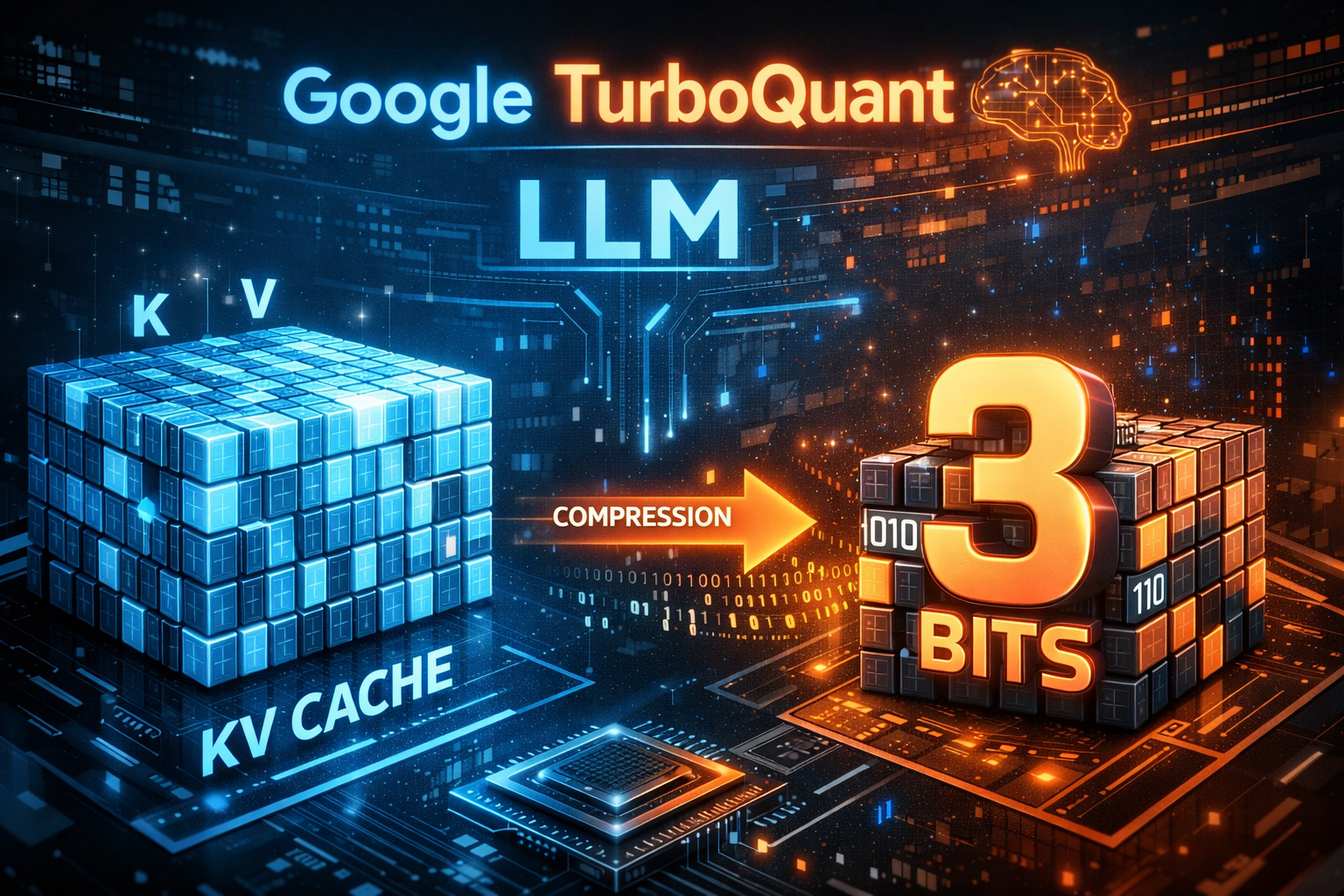
TurboQuant compresses high-dimensional vectors (like KV cache) to ~3 bits per value — with almost zero loss in accuracy.
Not 16-bit → 8-bit.
Not even 8-bit → 4-bit.
3 bits.
And somehow… it still works.
Why KV Cache Is the Real Problem
Every time a transformer generates a token, it stores:
- Keys (K)
- Values (V)
For every layer, every head, every token.
So memory grows like:
O(layers × heads × tokens × dimension)
At long context:
- 100K tokens → multiple GB per sequence
- Limits batch size
- Kills GPU utilization
- Drives up inference cost
This is why scaling context is expensive, not because of compute, but because of memory bandwidth and storage.
What Makes TurboQuant Different
Most quantization methods fall into two buckets:
1. Data-dependent (like Product Quantization)
- Requires training/codebooks
- Slow to adapt
- Hard to deploy dynamically
2. Simple quantization (like FP16 → INT8)
- Fast
- But loses too much signal at extreme compression
TurboQuant does something different:
It’s training-free, data-oblivious, and near-optimal (theoretically).
That combination is rare.
The Magic Trick: Turning Chaos into Structure
TurboQuant works because of one powerful idea:
👉 Step 1: Random Rotation
It rotates your vector into a new space where:
- All coordinates look similar
- Distribution becomes predictable (almost Gaussian)
This is huge.
Because now…
👉 Step 2: Scalar Quantization (Per Dimension)
Instead of complex vector quantization:
- Each coordinate is quantized independently
- Using optimal (Lloyd-Max) quantizers
Result:
- Simple
- GPU-friendly
- Highly efficient
👉 Step 3 (Optional): Fix the Error Smartly
For inner products (like attention), TurboQuant adds:
A 1-bit residual correction (QJL)
This:
- Removes bias
- Keeps attention accurate
- Preserves ranking
Why This Actually Works (Not Just in Theory)
TurboQuant isn’t just clever — it’s provably near-optimal.
It gets within:
~2.7× of the theoretical minimum error (Shannon bound)
In practice?
Even better.
Real-World Results
Here’s where things get interesting:
🚀 Memory Reduction
- ~6× smaller KV cache
⚡ Speed Improvement
- Up to 8× faster attention computation
💸 Cost Impact
- 50%+ reduction in inference cost
And the wild part?
At:
- 3–3.5 bits per value → no accuracy loss
- 2.5 bits → only minor degradation
Across benchmarks like:
- LongBench
- Needle-in-a-Haystack
- RULER
- L-Eval
Why This Matters (More Than It Seems)
TurboQuant isn’t just a compression trick.
It unlocks:
1. Longer Contexts
You can scale context without exploding memory.
2. Higher Throughput
More users per GPU.
3. Cheaper Inference
Massive cost savings for production systems.
But there’s a deeper implication:
We’re approaching the theoretical limits of compression for LLM inference.
That means future gains won’t come from better compression…
…but from a better system design around it.
Beyond LLMs: Vector Search Gets Better Too
TurboQuant also improves:
- Embedding compression
- ANN (Approximate Nearest Neighbor) search
Compared to traditional PQ:
- Better recall
- No training needed
- Instant indexing
This is huge for:
- RAG systems
- Vector databases
- Retrieval pipelines
Why This Is a Breakthrough
Most “breakthroughs” in AI are:
- Bigger models
- More data
- Better training
TurboQuant is different.
It’s a systems + theory breakthrough.
It:
- Combines math (Shannon limits)
- With practical engineering (GPU-friendly ops)
- Without retraining models
The Bigger Picture
If you’re building AI systems today, this changes how you think about:
- KV cache design
- Long-context architectures
- Serving infrastructure
- Cost optimization
Final Thought
For years, we optimized models.
Now, we’re starting to optimize how models run.
And TurboQuant is a glimpse of what that future looks like:
Smaller memory. Faster inference. Same intelligence.