Bionomics UM Lab — A Research Workspace That Remembers
Bionomics UM Lab — A Research Workspace That Remembers
Every day, life science researchers retrieve thousands of biological records.
A gene annotation comes from one database. A protein structure comes from another. Sequence analysis lives in a separate tool. Literature sits somewhere else. AI can explain pieces of the puzzle — but rarely remembers how the puzzle came together.
By the end of the day, the most valuable asset isn’t the data.
It’s the reasoning.
Unfortunately, that’s usually the first thing that’s lost.
The Hidden Problem in Bioinformatics
Modern bioinformatics has incredible databases and computational tools.
But the research workflow itself is surprisingly fragmented.
Researchers often find themselves juggling multiple browser tabs, notebooks, scripts, AI assistants, and spreadsheets just to answer a single biological question.
A typical workflow might look like this:
- Search for a gene.
- Retrieve its sequence.
- Run BLAST.
- Inspect a protein structure.
- Ask an AI assistant to explain the findings.
- Copy everything into a document.
- Repeat the process tomorrow because the context wasn’t preserved.
The biological evidence survives.
The scientific reasoning often doesn’t.
We asked ourselves a simple question:
What if research sessions had memory?
That question became the foundation of Bionomics UM Lab.
Introducing Bionomics UM Lab
Bionomics UM Lab is a workspace-centered bioinformatics research platform designed to combine structured biological retrieval, grounded AI reasoning, and persistent research memory into a single experience.
Instead of treating AI as the source of truth, the platform treats biological evidence as the source of truth and uses AI to help researchers interpret that evidence.
The result is a workflow that is designed to be more transparent, reproducible, and easier to resume over time.
A Workspace Built for Scientific Thinking
Research rarely follows a straight line.
A new hypothesis may emerge after several experiments, literature reviews, and discussions.
That’s why Bionomics UM Lab organizes work into dedicated research workspaces.
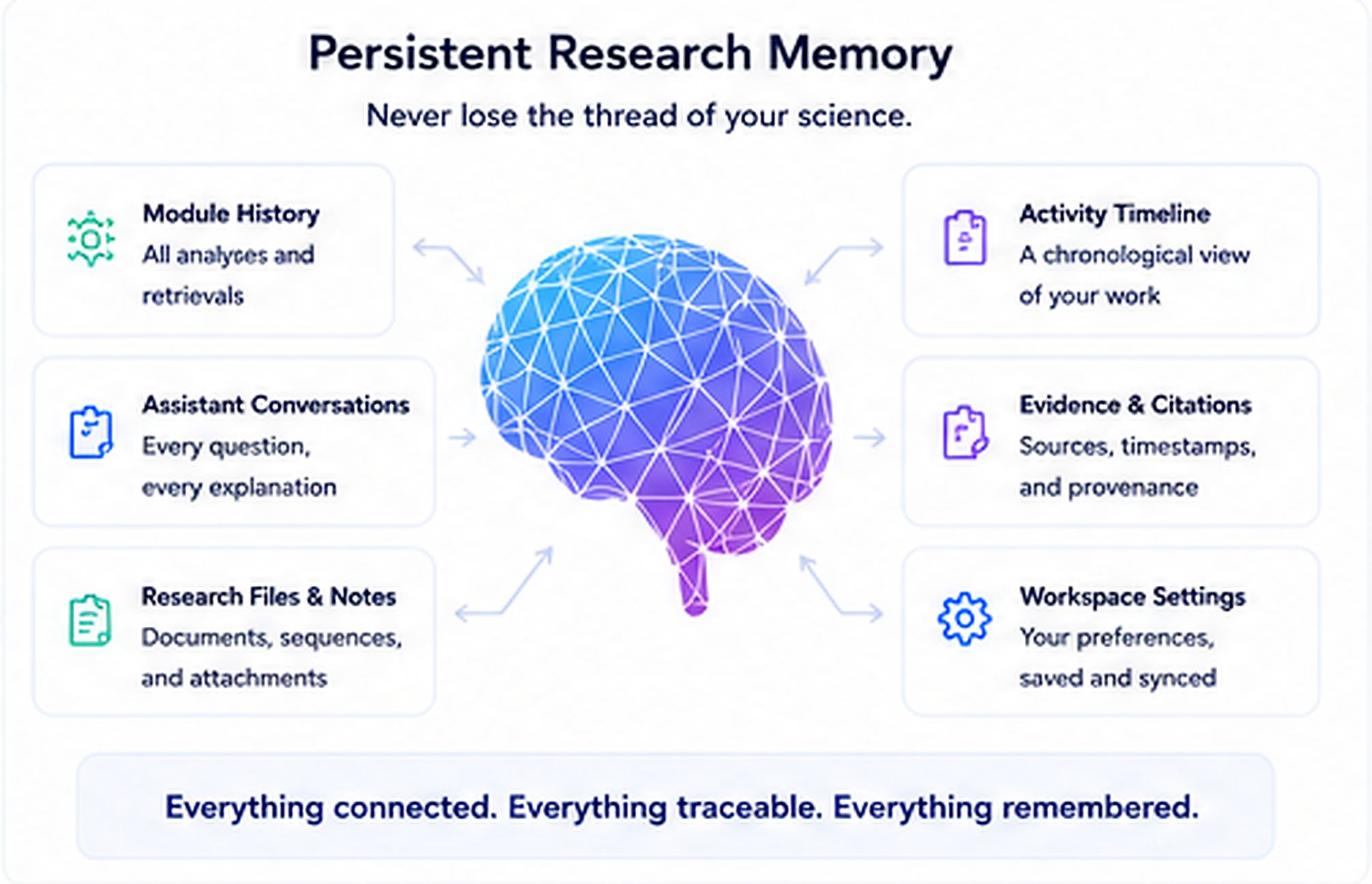
Each workspace maintains its own:
- research history
- assistant conversations
- activity timeline
- biological analyses
- configuration
- persistent context
Rather than starting from scratch each time, researchers can return to previous investigations with their evidence and reasoning intact.
Bioinformatics Modules That Work Together
Instead of relying solely on free-form AI conversations, the platform provides dedicated biological analysis modules.
Current capabilities include:
- Gene and transcript annotation lookup
- Sequence retrieval and translation
- Sequence similarity analysis (BLAST)
- Protein structure lookup (PDB)
- Virus exploration by host
Each module produces structured outputs that can be explored directly or passed into the AI assistant for interpretation.
This separation between retrieval and reasoning helps maintain a clear distinction between observed evidence and generated explanations.
AI That Explains Rather Than Guesses
Large language models are remarkably capable, but scientific research demands more than fluent answers.
Bionomics UM Lab’s assistant is designed to remain connected to retrieved biological evidence.
Instead of responding in isolation, it can work with:
- biological module outputs
- workspace context
- species hints
- previous analyses
- attached notes
The goal isn’t simply to answer questions.
It’s to help researchers understand what the underlying biological data is saying — and where uncertainty still exists.
Scientific Trust Starts with Provenance
One of the guiding principles behind the platform is simple:
Every important scientific conclusion should be traceable.
To support that goal, results emphasize:
- citations
- retrieval timestamps
- uncertainty notes
- source provenance
- structured biological records
Rather than hiding uncertainty, the platform makes it visible.
This allows researchers to better judge the strength of available evidence before moving forward.
Why Persistent Research Memory Matters
Perhaps the most distinctive aspect of the platform isn’t a single analysis module.
It’s the memory layer.
Every workspace can preserve:
- research activities
- assistant conversations
- module execution history
- evidence trails
- project evolution
This creates an auditable history of scientific exploration that is easier to revisit, reproduce, and share with collaborators.
Instead of asking:
“What did I search last week?”
Researchers can ask:
“How did we arrive at this conclusion?”
That difference becomes increasingly valuable as projects grow in complexity.
Who Can Benefit?
Bionomics UM Lab is designed for researchers who need to move between biological data and scientific interpretation without constantly switching tools.
Potential users include:
- Bioinformatics researchers
- Molecular biologists
- Genetics students
- University teaching laboratories
- Translational research groups
- Early-stage biotechnology teams
- Wet-lab scientists seeking computational support
The platform is particularly well-suited to evidence exploration and collaborative research rather than to large-scale production pipeline automation.
Looking Beyond Bioinformatics
While today’s platform focuses on biological research, the underlying philosophy extends much further.
Scientific discovery isn’t just about collecting data.
It’s about preserving context, reasoning, evidence, and decisions.
Bionomics UM Lab represents an early step toward research environments where scientific knowledge becomes a persistent, searchable memory rather than a collection of disconnected analyses.
The Road Ahead
We’re continuing to expand the platform with richer biological modules, stronger collaboration capabilities, improved research memory, and more advanced AI-assisted interpretation while keeping evidence, provenance, and reproducibility at the center of every workflow.
Our long-term vision is simple:
Build research software that doesn’t just answer questions.
Build research software that remembers.
We’d Love Your Feedback
Bionomics UM Lab is actively evolving, and we’re especially interested in hearing from:
- academic researchers,
- graduate students,
- computational biologists,
- molecular biologists,
- educators,
- and biotech teams.
What slows down your research workflow today?
What would make evidence-backed scientific exploration more effective?
Your feedback will directly influence the next generation of the platform.