From Genome Models to Research Memory: What AlphaGenome Means for Bionomics UM Lab
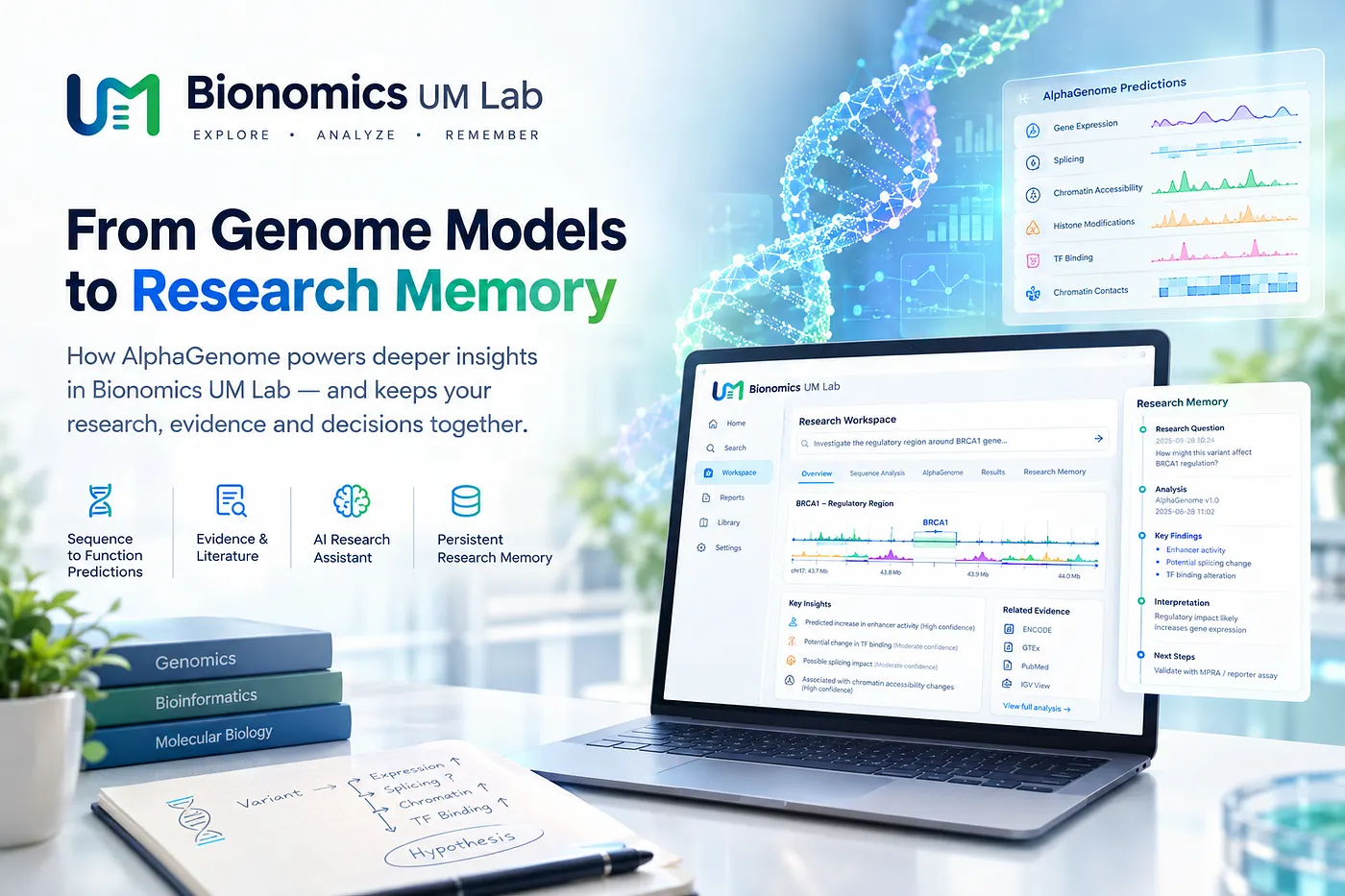
We are exploring how AlphaGenome can become part of a research workspace that does more than analyze biology — it remembers how the analysis was done.
Biology is entering an unusual moment.
We are no longer limited to asking computers to search biological databases.
AI systems can now begin to reason over DNA sequences, predict molecular consequences, connect signals across genomic regions, and help researchers prioritize what deserves experimental attention.
One key example is AlphaGenome, Google DeepMind’s DNA sequence-to-function model.
AlphaGenome can take up to 1 million bases of DNA and predict thousands of functional genomic signals across gene expression, transcription initiation, chromatin accessibility, histone modifications, transcription-factor binding, splicing, and chromatin contacts. The Nature paper reports state-of-the-art performance on 22 of 24 genome-track prediction tasks and 25 of 26 variant-effect prediction tasks.
But for us, the interesting question is not simply:
“How powerful is AlphaGenome?”
The more important question is:
“What happens when a model like AlphaGenome becomes part of a research workspace that remembers the scientist’s entire investigation?”
That is where Bionomics UM Lab comes in.
Bionomics UM Lab: A Research Workspace That Remembers
We are building Bionomics UM Lab around a simple idea:
Scientific research should not lose its context.
A researcher should not have to repeatedly reconstruct:
- which gene they investigated
- which sequence they analyzed
- which database they queried
- which model produced a prediction
- which variant was considered important
- what evidence supported a conclusion
- which questions remain unanswered
- why a particular experiment was chosen
Today, much of this context gets fragmented across notebooks, browser tabs, papers, scripts, local files, databases, and conversations.
The scientific result may survive.
The reasoning path often does not.
Bionomics UM Lab is our attempt to create a persistent research environment where evidence, analysis, AI reasoning, and research activity can live together.
And AlphaGenome gives us an exciting new direction for that workspace.
Why AlphaGenome matters to Bionomics
Our current Bionomics workflow already focuses on evidence-first biological exploration.
Researchers can work with capabilities such as:
- Gene and transcript information
- Sequence retrieval
- BLAST-based discovery
- Grounded AI explanations
- Persistent workspaces
- Research activity history
The goal is not to build another generic chatbot.
It is to create a place where a researcher can move from:
Question → Evidence → Analysis → Interpretation → Research memory
AlphaGenome potentially extends this pipeline.
Instead of stopping at:
“Here is the sequence.”
we can begin exploring:
“What might this sequence do?”
And instead of stopping at a prediction, Bionomics can ask:
“What evidence led us here, what did the model predict, and what should we investigate next?”
That distinction is fundamental.
From retrieval to computational experimentation
Consider a researcher investigating a gene.
Today, the workflow might look like:
Find gene ↓Retrieve annotation ↓Retrieve sequence ↓Search similar sequences ↓Read papers ↓Form hypothesis
With sequence-to-function models, another layer becomes possible:
Find gene ↓Retrieve genomic context ↓Run sequence-to-function prediction ↓Explore regulatory signals ↓Score variants ↓Compare reference vs alternative sequence ↓Form hypothesis
Now add research memory:
Question ↓Evidence ↓Sequence ↓AlphaGenome analysis ↓Predicted effects ↓Interpretation ↓Research decision ↓Saved research context
This is the direction we are exploring with Bionomics.
What could AlphaGenome look like inside Bionomics?
We don’t want researchers to need a separate notebook every time they want to investigate a genomic region.
The long-term vision is to make AlphaGenome-style analyses feel native to the workspace.
Imagine opening a research workspace and asking:
“Investigate the regulatory region surrounding this gene.”
Bionomics could retrieve the genomic context and organize the investigation.
Then the workspace could expose a research workflow such as:
Gene / Variant ↓Genomic Context ↓AlphaGenome Prediction ↓Expression ↓Splicing ↓Chromatin ↓TF Binding ↓Chromatin Contacts ↓Evidence & Interpretation ↓Research Memory
The important part is not only the prediction.
It is what happens around the prediction.
AlphaGenome + Bionomics: two different kinds of intelligence
There is a useful division of responsibilities here.
AlphaGenome
AlphaGenome is designed to model the relationship between DNA sequence and molecular genomic phenotypes.
It provides predictions.
Bionomics
Bionomics is designed around the researcher’s workflow.
It provides:
- context
- evidence
- workspace persistence
- interpretation
- history
- research organization
- AI assistance
Together, they can create something more powerful than either component alone.
Think of it as:
Biological intelligence + Research memory
The model answers:
“What might this sequence do?”
The workspace remembers:
“Why were we investigating it, what did we find, and what should happen next?”
A practical example: investigating a variant
Imagine a researcher finds a variant near a gene associated with a disease phenotype.
The variant is in a non-coding region.
This is exactly the kind of problem where traditional coding-focused annotation can become difficult.
The researcher starts with:
Variantchr7:XXXXXXXXREF: AALT: G
Bionomics could build a research investigation around it.
Step 1 — Context
Retrieve the relevant genomic interval and nearby genes.
Step 2 — Annotation
Understand transcripts, regulatory regions, and known biological evidence.
Step 3 — Sequence
Retrieve the reference sequence around the variant.
Step 4 — Variant analysis
Compare reference and alternative sequences using AlphaGenome.
AlphaGenome’s API explicitly supports sequence prediction, variant prediction, variant scoring, and in-silico mutagenesis workflows.
Step 5 — Multimodal interpretation
Investigate predicted changes in:
- gene expression
- splicing
- chromatin accessibility
- transcription-factor binding
- regulatory activity
- chromatin contacts
Step 6 — Evidence
Connect these computational predictions with literature and biological databases.
Step 7 — Research memory
Store:
- what was analyzed
- when it was analyzed
- which model/version was used
- what predictions were produced
- what evidence supported them
- what the researcher concluded
- what remains uncertain
Now the analysis becomes part of the research record.
This is where “memory” becomes scientifically useful
Memory in an AI research system should not mean simply storing a chat history.
For scientific work, memory needs structure.
A useful research memory might look like:
Research Question ↓Biological Entity ↓Evidence ↓Sequence ↓Analysis ↓Model ↓Prediction ↓Interpretation ↓Decision ↓Next Experiment
That creates something much closer to a research knowledge graph or research timeline than a chatbot transcript.
And this is particularly important for AI-generated results.
A prediction without provenance is difficult to trust.
A prediction connected to:
- input sequence
- model
- parameters
- source
- timestamp
- evidence
- interpretation
- uncertainty
becomes much more useful.
We want to preserve uncertainty too
There is another principle that matters deeply to us.
AI should not turn biological uncertainty into false certainty.
AlphaGenome itself has important limitations. DeepMind notes that predicting effects of very distant regulatory elements remains challenging, and that improving cell- and tissue-specific modeling is an ongoing area of research. It is also not designed or validated for personal genome prediction or clinical decision-making.
Bionomics should preserve this uncertainty rather than hide it.
A future result could therefore look like:
PredictionHigh confidence
EvidenceStrong
Biological interpretationModerate confidence
Known literature supportLimited
Experimental validationNot available
This creates a more responsible research experience.
The goal is not:
“AI says this is true.”
It is:
“AI predicts this. Here is why. Here is the supporting evidence. Here is what we don’t know.”
From AI answers to research artifacts
One of the changes we want to make in Bionomics is to turn AI interactions into persistent research artifacts.
For example:
1. Gene Investigation
A saved workspace containing the gene, annotations, literature and computational analysis.
2. Variant Investigation
A reusable record of reference vs alternative sequence predictions.
3. Regulatory Investigation
A genomic region with predicted expression, accessibility, TF binding and other regulatory signals.
4. Splicing Investigation
Potential changes in splice sites and junction usage.
5. Hypothesis
A structured statement generated from the evidence:
“Variant X may alter regulatory activity affecting Gene Y in cell type Z.”
6. Research Decision
“Prioritize this variant for experimental validation.”
The difference is subtle but important.
The AI response becomes part of the research process, not a disposable chat message.
AlphaGenome also changes the role of the AI research assistant
This is where we see a particularly interesting opportunity.
Today, an AI research assistant may answer:
“What is this gene?”
In a more capable scientific workspace, it could reason through a workflow:
“What is this gene, what regulatory region surrounds it, what variants are known, which variants appear functionally interesting, what does the available literature say, and what should I investigate next?”
That is a completely different class of system.
The assistant becomes a coordinator between:
- biological databases
- sequence tools
- literature
- AI models
- research history
- scientific reasoning
And the workspace remembers the outcome.
We are not trying to replace the scientist
This is an important part of our vision.
Bionomics is not designed to say:
“Here is the answer.”
It should help the researcher get to a better question.
For example:
AI prediction:
Variant A is predicted to decrease regulatory activity.
The researcher can then ask:
“Is that consistent with existing literature?”
Then:
“Is the affected gene expressed in the relevant tissue?”
Then:
“Are there known eQTLs nearby?”
Then:
“Could this affect splicing instead?”
Then:
“What experiment could distinguish these hypotheses?”
This is the difference between an AI assistant and a research partner.
The opportunity is bigger than AlphaGenome
AlphaGenome is one important component of a much larger ecosystem.
Bionomics already explores tools and scientific resources such as:
- sequence retrieval
- gene annotation
- BLAST
- scientific databases
- grounded AI
- research history
The future workspace can connect these capabilities.
Conceptually:
This is the direction we are exploring.
And this is where Bionomics becomes more than a bioinformatics tool
A conventional bioinformatics tool usually answers a narrow question.
A research workspace can connect many questions together.
For example:
Gene ↓Transcript ↓Sequence ↓Variant ↓Regulatory effect ↓Literature ↓Hypothesis ↓Experiment
And importantly:
The workspace remembers the chain.
That is the core idea behind Bionomics UM Lab.
Research should have memory.
Why we are sharing this now
We are still building.
That matters.
We don’t want to assume that we already know exactly how researchers should use AI models such as AlphaGenome.
We want to discover that with researchers.
There are many questions we want answered.
What would you actually use AlphaGenome for?
Would it be:
- variant prioritization?
- gene regulation?
- splicing analysis?
- non-coding variant interpretation?
- disease research?
- experimental planning?
What should Bionomics remember?
Should it remember:
- every sequence?
- every prediction?
- every hypothesis?
- only important research decisions?
What would make the workspace genuinely useful?
Would you prefer:
- a visual genomic workspace?
- an AI research assistant?
- automated reports?
- variant investigation workflows?
- persistent research notebooks?
- evidence graphs?
We genuinely want to know.
We are opening the Bionomics Lab to researchers
Bionomics UM Lab is being developed by UniteMemory around one broader research idea:
How can AI systems preserve and compound scientific knowledge instead of making every research session start from zero?
AlphaGenome gives us an exciting opportunity to test that idea.
Rather than simply integrating another model into another interface, we want to explore what happens when
advanced biological models + scientific evidence + AI reasoning + persistent research memorycome together in a single workspace.
And we want researchers to shape that direction.
Help us build it
We are looking for researchers, computational biologists, bioinformaticians, students, and anyone working with biological data who is willing to try Bionomics and tell us what is missing.
You don’t need to tell us that everything is great.
Actually, we would prefer the opposite.
Tell us:
What is frustrating?
What takes too long?
What information do you repeatedly search for?
What should an AI research assistant remember?
Where would AlphaGenome be genuinely useful to you?
What would make you return to the workspace every day?
That feedback will directly influence what we build next.
The bigger vision
AlphaGenome points toward a future where AI can interpret increasingly complex layers of genomic regulation.
Bionomics is exploring a complementary question:
How do we turn those AI capabilities into a persistent scientific research process?
Not just: Analyze.
But: Analyze → Understand → Record → Connect → Remember → Revisit → Discover.
That is the kind of research workspace we want Bionomics UM Lab to become.
A place where a researcher can explore a gene today and come back months later without losing the context.
A place where a prediction does not disappear into a chat window.
A place where evidence and reasoning accumulate over time.And ultimately, a place where scientific memory compounds.
🧬 Try Bionomics UM Lab
We are inviting researchers to join the early community and help shape the next version of the workspace.
Bionomics UM Lab — A Research Workspace That Remembers.
👉 https://bionomics-umlab.com/
We are especially interested in hearing from researchers working on genomics, bioinformatics, molecular biology, computational biology, variant interpretation, and AI for science.
Try it. Break it. Question it. Tell us what we should build next.
Because the best version of a scientific research workspace shouldn’t be designed in isolation.
It should be built with the people who use it.
Bionomics UM Lab is a research product developed by UniteMemory, a research and development initiative exploring memory systems for scientific and other complex knowledge workflows.
AlphaGenome is a research model from Google DeepMind. Its current access and usage terms, API availability, and research-only restrictions should be checked against the official AlphaGenome documentation before deployment in any workflow.